

I. Sodium stannate trihydrate CAS 12209-98-2 introduce
Sodium stannate trihydrate serves as the primary salt in alkaline tin plating; it forms a complex salt with sodium hydroxide that dissolves in the plating solution. When current is applied, the tin—contained within anionic complexes—is reduced at the cathode. The typical concentration ranges from 75 to 90 g/L. It also functions as an auxiliary primary salt in cyanide copper-tin alloy plating, as well as in pyrophosphate and stannate-based copper-tin alloy plating processes. Additionally, this product is used in the printing and dyeing industry as a mordant and for pigment precipitation, and finds application in the manufacture of ceramics, glass, and fire-resistant fabrics.
II. A “Stable Tin Source” for Alkaline Systems
Sodium stannate supplies tetravalent tin ions (Sn⁴⁺), which exist in strongly alkaline plating baths as stable complex anions—specifically, [Sn(OH)₆]²⁻. This characteristic fundamentally distinguishes it from acidic tin plating systems, which utilize divalent tin salts such as stannous sulfate.
Why is a tetravalent tin source so critical? Alkaline environments are inherently unsuitable for the stability of divalent tin. In strong alkali, divalent tin tends to undergo spontaneous disproportionation, yielding spongy metallic tin and tetravalent tin; this instability was precisely why early “stannate” baths formulated from stannous chloride and caustic soda failed to produce viable plating deposits. The introduction of sodium stannate circumvents this issue at the source: the tetravalent tin it provides is thermodynamically stable under alkaline conditions, ensuring the plating bath does not undergo “spontaneous degradation” caused by the instability of the tin source itself.
III. A “Multifunctional Role” in Process Control
In the plating bath, sodium stannate serves as more than just a source of tin; it also plays a key role in process control in the following ways:
Maintaining chemical balance. Sodium stannate works in conjunction with free sodium hydroxide to prevent the hydrolysis of tin ions, which would otherwise form insoluble tin hydroxide precipitates. If such precipitates form, they can become embedded in the plating deposit as particles, compromising the coating’s continuity and adhesion. The strongly alkaline environment maintained by sodium stannate ensures that tin ions remain in a soluble, complexed state.

Suppressing harmful impurities. A major risk in alkaline tin plating is the accumulation of divalent tin ions (Sn²⁺), which can cause the coating to become dark and porous. The highly alkaline environment of the sodium stannate system inherently helps suppress the formation of divalent tin; furthermore, hydrogen peroxide is often added to the process to oxidize any accumulated divalent tin back into the tetravalent state (Sn⁴⁺). This “self-purifying” mechanism allows the sodium stannate bath to operate over extended periods; patented data indicates that, with strict control of free alkali levels, the bath can run continuously for months without the need to replenish the primary sodium stannate salt.
Facilitating proper anode dissolution. In alkaline tin plating, a golden-yellow oxide film must form on the surface of the tin anode; this film ensures that tin dissolves into the solution in the tetravalent state rather than undergoing abnormal dissolution as divalent tin. The specific free alkali concentration range required by the sodium stannate system is the critical factor in maintaining this film-forming state.
IV. The Boundaries of Irreplaceability: Competition from Potassium Stannate
It is important to clarify that the “irreplaceability” of sodium stannate has limits. Potassium stannate is a direct competitor within the alternative technical pathway of alkaline tin plating, holding advantages in specific performance metrics.
Potassium ions possess higher mobility than sodium ions, resulting in higher bath conductivity; this allows for the use of higher cathode current densities and yields superior deep-plating and throwing power. Potassium stannate is the preferred choice for applications requiring high-speed plating and high current densities (such as continuous strip tin plating). However, in cost-sensitive low-end markets and the plating of standard electronic components, sodium stannate dominates due to its significant cost advantage.
V. “Functional Irreplaceability” in Application Scenarios
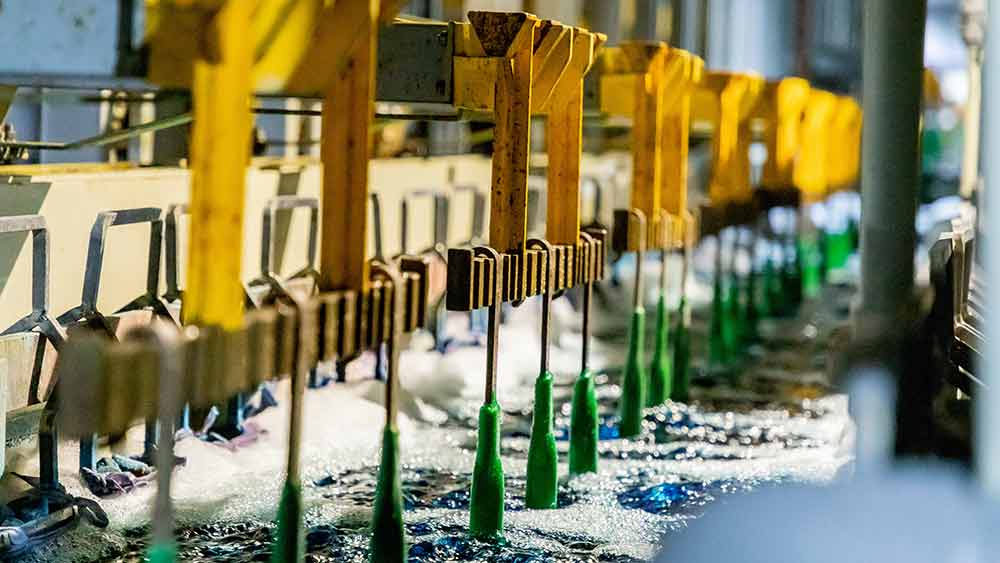
In the following specific scenarios, the functionality of sodium stannate (or potassium stannate) systems cannot be easily replicated by other processes:
Tin plating of battery tabs for new energy vehicles. The adhesion of the tin coating on battery tabs directly impacts the reliability of battery welding. Alkaline stannate systems (sodium or potassium) increase cathodic polarization, ensuring the rate of crystal nucleation exceeds the rate of crystal growth; this produces a dense, fine-grained coating with strong adhesion. Acidic tin plating systems struggle to achieve the same level of crystallization control in these applications.
Hydrogen-embrittlement-free tin plating for high-strength components. Acidic tin plating processes involve significant hydrogen evolution, which can cause hydrogen embrittlement cracking in components made of high-strength steel or spring steel. Alkaline stannate systems operate in an alkaline environment throughout the process with minimal hydrogen evolution, making them a “safe plating process” for such components. This functional requirement renders acidic systems unsuitable.
Uniform plating of complex-shaped electronic components. Alkaline stannate baths offer superior dispersing and covering power compared to acidic baths, enabling more uniform tin deposition on surfaces featuring deep holes, blind holes, and irregular geometries.
In short, the irreplaceability of sodium stannate does not imply absolute uniqueness; rather, within the technical framework of “alkaline cyanide-free tin plating,” it offers the stability of a tetravalent tin source and process controllability at the lowest cost. In conventional electroplating scenarios that are cost-sensitive and have requirements regarding hydrogen embrittlement and coating uniformity, there is still no equivalent alternative to this combination.

VI. Sodium stannate trihydrate Industry Outlook
As an established fine chemical product, the demand base for sodium stannate trihydrate is underpinned by the essential requirements of the electroplating industry. The core evolutionary trajectory of the sector is clearly defined: on the production side, the trend is shifting toward lower processing temperatures and the recycling of waste materials, while on the demand side, the focus is moving toward higher purity and consistent batch quality. Amidst this evolution, leading enterprises—leveraging their technical expertise and economies of scale—are expected to further consolidate their market positions.
