

Amid the green chemical industry boom, sodium metaaluminate empowers efficient upgrades across multiple sectors with its formidable capabilities.
With the deepening of dual-carbon policies and increasingly stringent environmental compliance requirements, green efficiency and multifunctional adaptability have become core competitive advantages for chemical products. As an ‘all-rounder’ in inorganic chemistry, sodium aluminate leverages its stable physicochemical properties and diverse application scenarios to serve as a pivotal enabler for cost reduction, efficiency gains, and compliance upgrades across water treatment, construction, chemical, and light industrial sectors. Aligning with national green chemical development directives while precisely addressing enterprise production challenges, it emerges as a sought-after essential product in the 2026 chemical market.
Ⅰ .Core Product Overview: Robust Properties Unlock Multi-Scenario Applications
Sodium aluminate (NaAlO₂), appearing as a white amorphous crystalline powder, is readily soluble in water, odourless and tasteless. Its aqueous solution exhibits strong alkalinity and is insoluble in ethanol. Key advantages include high hygroscopicity, superior purity, and excellent reactivity. Manufactured via clean production processes compliant with ISO 9001standards, it features uniform particle size and stable colour. Customised formulations with specific concentrations can be produced to meet client requirements, balancing practicality with regulatory compliance. Its core functionality centres on ‘high-efficiency synergy and green adaptability,’ catering to diverse industrial production needs and resolving various operational challenges.
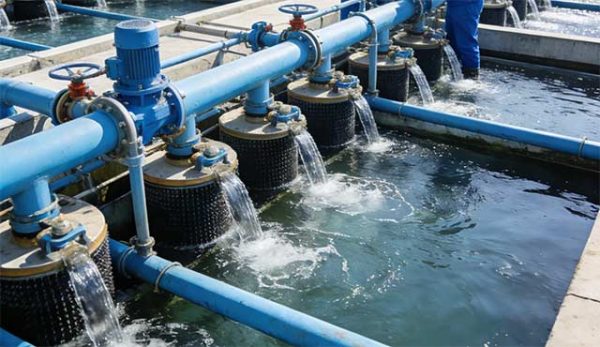
1.High-Efficiency Flocculation and Purification: Upon hydrolysis, it generates aluminium hydroxide that rapidly adsorbs suspended solids, impurities, and harmful ions from water bodies.
Phosphorus removal efficiency reaches 99.8%, with residual phosphorus below 0.1mg/L. Compared to conventional chemicals, it reduces sludge production by 60%, offering high purification efficiency and environmental sustainability. Minimal additional auxiliary chemicals are required, lowering treatment costs while meeting environmental discharge standards.
2. Rapid Setting and Strength Enhancement: Sodium aluminate exhibits outstanding rapid-setting properties, significantly reducing concrete initial setting time to 5 minutes while tripling strength development rate.
Presents no risk of chloride ion corrosion to reinforcing steel, enhancing building materials’ compressive strength, impermeability, and frost resistance. Also functions as a soil stabiliser, effectively mitigating soil erosion.
3. Catalytic and Synthetic Adaptability: Sodium aluminate as a key source of highly reactive alumina, Sodium aluminate serves as a catalyst and carrier for petroleum hydrocarbon conversion, enhancing catalytic efficiency.
Sodium aluminate is also a core raw material for manufacturing molecular sieves, activated alumina, and titanium dioxide modification. High-crystallinity 4A molecular sieves can be synthesised at low temperatures (80°C), achieving rates ten times faster than traditional methods, thereby boosting quality and efficiency in chemical synthesis.
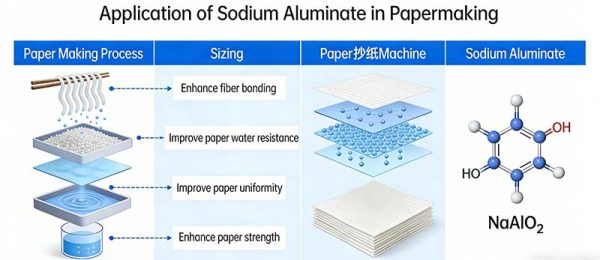
4. Multifunctional Auxiliary Optimisation: Combining setting, retention aid, and sizing synergistic functions, Sodium aluminate optimises product performance while exhibiting excellent stability and compatibility.
Sodium aluminate interacts synergistically with various chemicals and raw materials without adverse effects, adapts to diverse production processes, and requires minimal production equipment modification, thereby reducing enterprise technical upgrade costs.
Ⅱ.Core Application Scenarios: Multi-industry coverage with pronounced essential utility
Sodium aluminate’s application spans multiple core sectors of the national economy. Its multifunctional properties render it an indispensable chemical additive in diverse industrial production processes, precisely addressing contemporary corporate imperatives for compliant manufacturing, cost reduction, and efficiency enhancement.
1. Water treatment sector: Serving as an efficient auxiliary coagulant, Sodium aluminate is extensively applied in industrial water treatment, municipal water purification, and sewage processing.
It reduces water hardness and accelerates the settling of suspended solids, proving particularly effective for challenging industrial wastewater treatment.
Currently, the majority of domestic market demand is concentrated within the water treatment sector.
2. Construction Engineering Sector: Primarily employed as a concrete accelerator, Sodium aluminatesuits diverse construction scenarios including bridges, tunnels, and roads, significantly shortening construction cycles while enhancing project progress and quality.
Additionally, Sodium aluminate functions as a cement additive to improve cement stability and compressive strength.
Sodium aluminate may also react with water glass for soil reinforcement, water blocking, and coal seam fire suppression, thereby supporting efficient construction practices.
3. Petrochemical Sector: Serves as a catalyst carrier and feedstock for petroleum hydrocarbon conversion and isomerisation reactions, enhancing catalyst activity and stability.
Additionally functions as a thickener for acid fracturing fluids and a crosslinking agent for water blocking and profile control agents, boosting oil extraction efficiency while meeting the petrochemical industry’s green upgrade requirements.
4.Light Industry Manufacturing Sector:
Within papermaking, Sodium aluminate functions as a filler, retention aid, and sizing synergist, improving paper smoothness, toughness, and brightness while reducing ink penetration.
In textiles, Sodium aluminate serves as an additive to enhance fibre dyeability, antistatic properties, and anti-pilling characteristics.
In leather processing, Sodium aluminate acts as a tanning agent to elevate leather quality, meeting the refined production demands of light industries.
New Materials and Other Fields: As an aluminium source for lithium battery cathodes, it enhances the battery’s cycle capacity retention rate, supporting the advancement of new energy materials. Simultaneously, Sodium aluminate finds applications in glass and ceramic etching, steel surface treatment and protection, soap manufacturing, and fertiliser production. It also serves as a raw material for producing various crystalline forms of alumina and stabilising silica gel solutions, with its application scenarios continually expanding.
Unilong Industry Co., Ltd. is a leading company in the production of sodium aluminate, our company is acutely aware that green chemistry has become the prevailing trend in the industry, with environmental compliance and efficient production emerging as core corporate imperatives. Sodium aluminate, leveraging its multifunctionality, broad adaptability, and ecological advantages, transcends the limitations of traditional chemical additives. It not only assists enterprises in reducing production costs and enhancing operational efficiency but also supports compliance with environmental regulations, enabling businesses to navigate the green barriers posed by the EU’s Carbon Border Adjustment Mechanism (CBAM). Selecting premium sodium metasilicate in Unilong Industry Co.,Ltd. means choosing an efficient, compliant, and green production solution. Together, let us embrace new opportunities for high-quality development in the chemical industry!
